RED SIGNAL

Red Signal

Nobody shares a red planet. Somebody takes it.

You are an operator on Earth. Your chassis is on a dead planet, and the only thing between you is a quantum link. Five minutes, eight machines, one relay at the centre of the zone. Hold the signal and you hold the planet.

Runs in your browser · live players or bots

01 / The operator

You are not there — and that is the point

The chassis burns; the operator does not. The next one is waiting three seconds later, not an evening later. So nobody digs in here: losing a machine is cheaper than losing the point.

No people on the ground, ever — the air is unbreathable and the cold kills electronics faster than it kills anyone. Two corporations fight by proxy: VEGA against HELIX.
02 / The link

The link is the front line

Control runs down a chain of relay masts your team raises itself, from the deployment pad out towards the fighting. Inside coverage there is no lag at all. Past the edge it is 250 ms, and every shot becomes a question of lead. Further out, 600 ms — no longer a fight, just slow walking.

Which makes the best sabotage a mast behind enemy lines rather than a frontal push. Drop it and the coverage beyond goes dark, taking their assault with it.

03 / Signal mode

Five minutes to take a planet

The relay at the centre pays three points a second to whoever holds it, and a thousand points ends the match. Holding alone never gets you there, so the win goes to the side that does all of it at once: hold the circle, break enemy chassis, haul the cargo home.

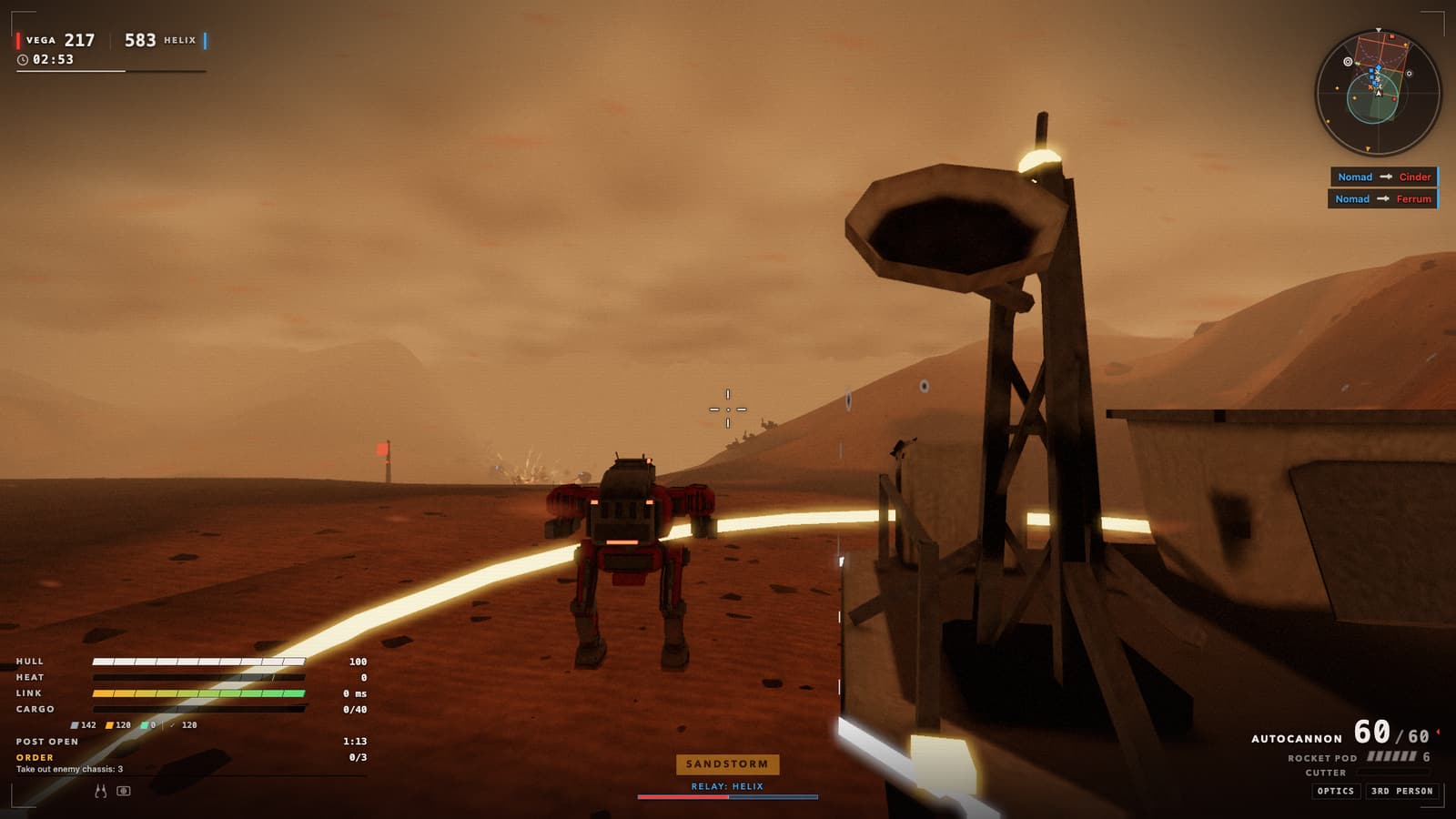
A sandstorm arrives on the two- and four-minute marks. Optics go blind, infrared comes into its own, and the relay changes hands exactly when nobody can see fifty metres ahead.

Mechanics

Four things that decide a match

Nothing spare: the point, the link, the heat and the cargo. Everything else follows from those.

01

The point pays

The relay at the centre gives its owner three points a second. Capture runs faster the more live chassis you park inside the circle, and an empty point drifts slowly back to whoever held it last.

hold · 3 pts/s · match to 1000

02

Latency as a weapon

Your team raises the masts. Past the edge of coverage the controls turn to syrup; off the chain entirely the link snaps and the abandoned chassis freezes where it stands.

link · 0 → 250 → 600 ms

03

Heat and damage

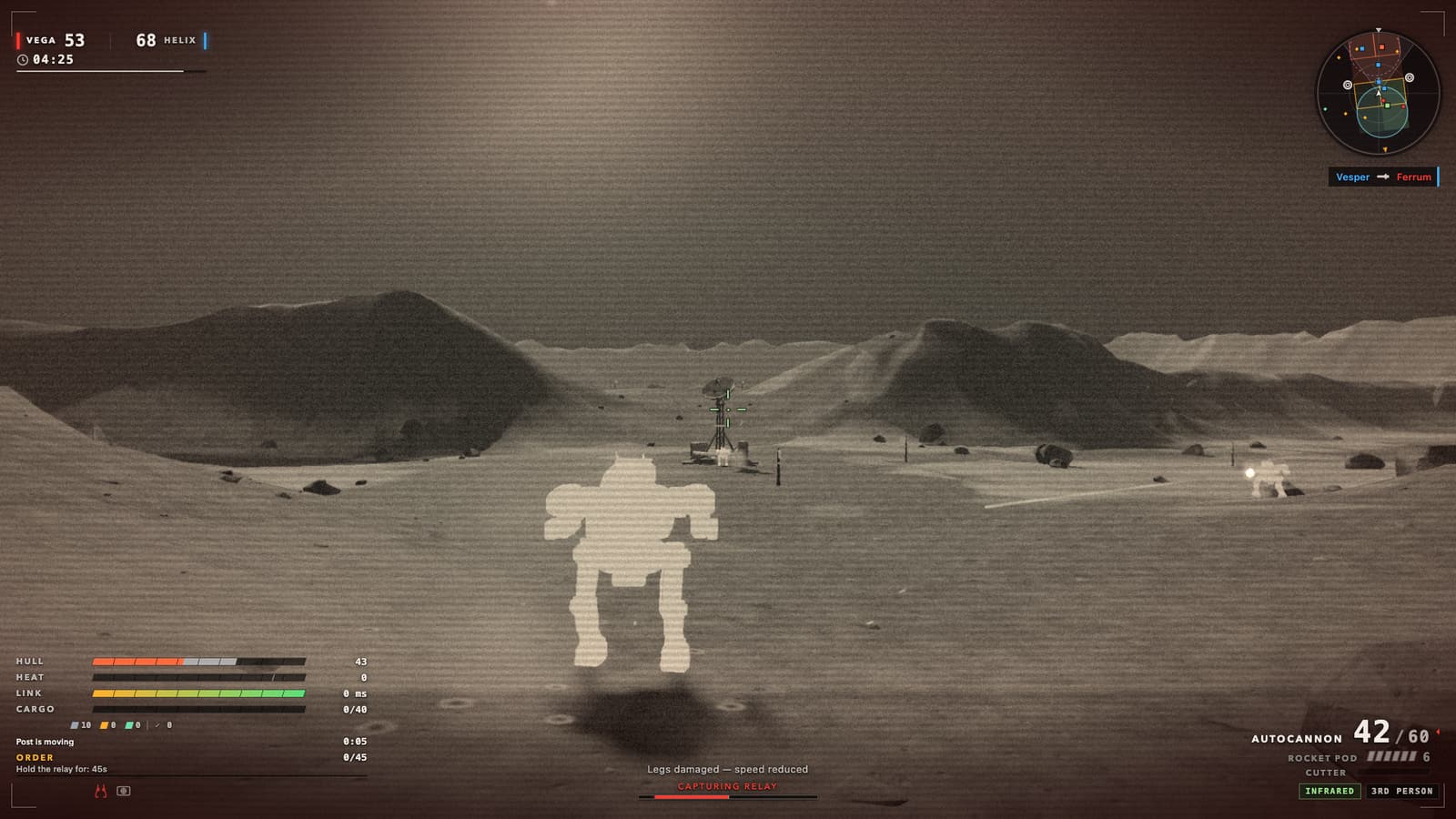
Firing heats the barrels and an overheat locks them for several seconds. Damage lands by zone: broken legs cost you speed, shattered optics cost you sight. Infrared reads heat through dust — but never a target that has cooled.

hull · legs · optics · IR

04

Economy between fights

The drill chews veins, the cutter strips enemy wrecks, the welder patches allies. Cargo goes to the outpost, scrap turns into new masts, and a personal order pays out to the whole team.

ore · scrap · isotopes · orders

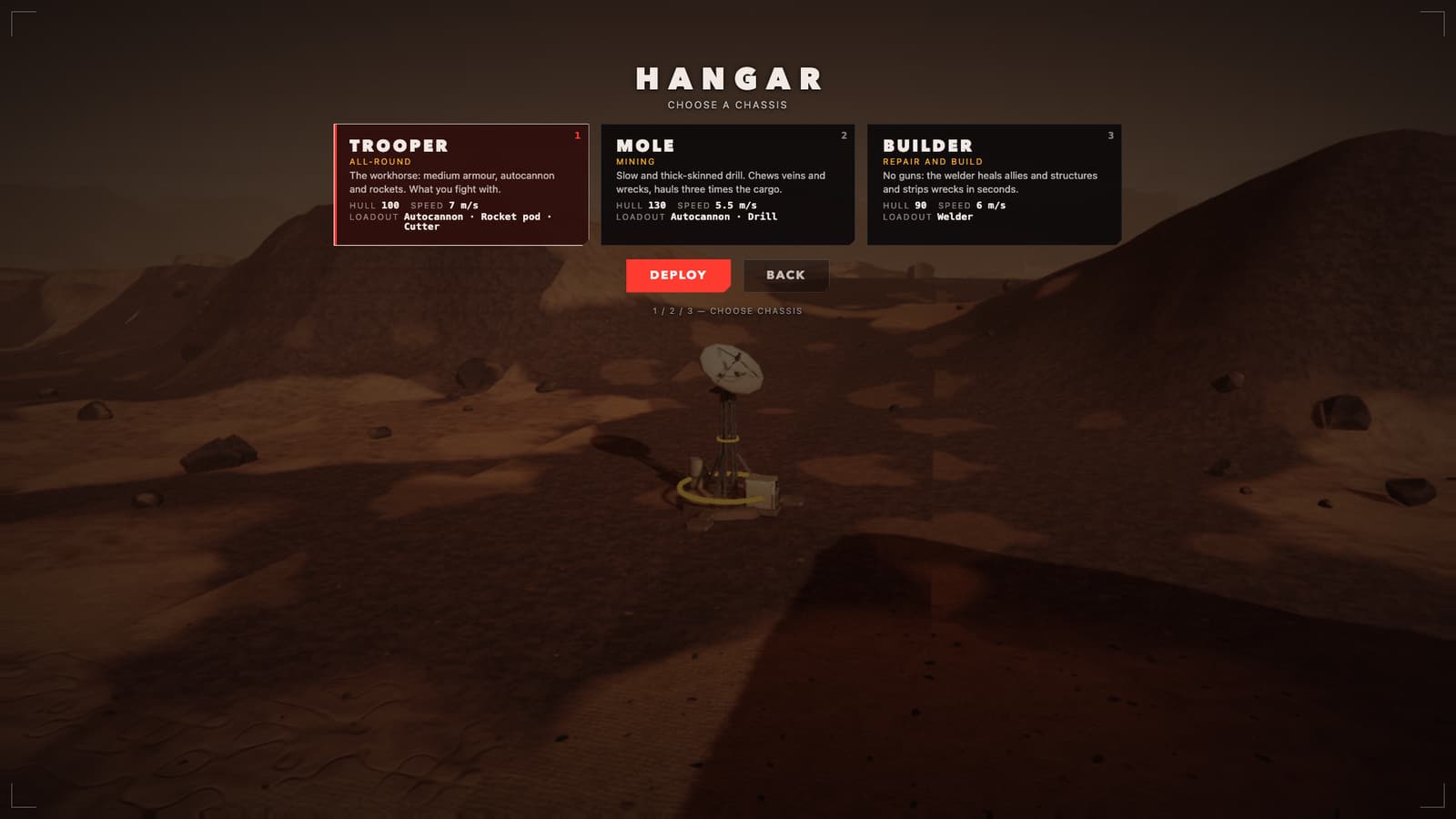
Hangar

Three chassis. Picked before every sortie

Not character classes — hulls you connect to. Die, connect to another one, go do a different job.

All-round

Trooper

The workhorse: medium armour, autocannon and rockets. What you fight with.

Mining

Mole

Slow and thick-skinned drill. Chews veins and wrecks, hauls three times the cargo.

Repair and build

Builder

No guns: the welder heals allies and structures and strips wrecks in seconds.

Frames

What it looks like

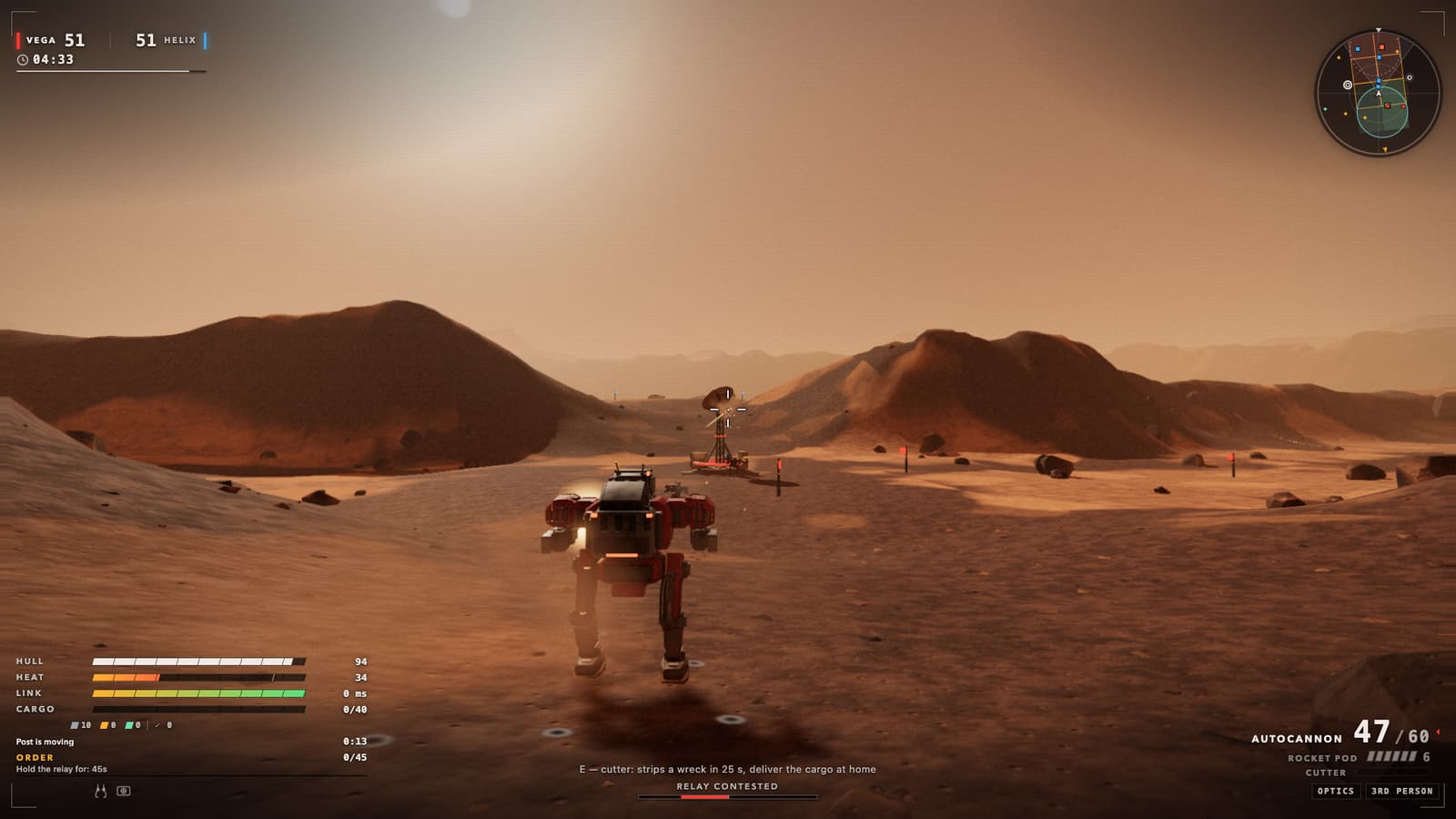
A Trooper chassis facing the relay at the centre of the zone
Point contested. While both sides stand in the circle, nobody scores.
Infrared view: glowing mech silhouettes against a cold desert
Infrared. Heat reads through the dust — until the target cools down.
Sandstorm over the outpost, visibility collapsing
Sandstorm. It arrives on the match clock and cancels every long-range weapon.
Hangar screen with three chassis cards: Trooper, Mole and Builder
Hangar. Three hulls, three jobs, three seconds between them.

From the front

Straight out of the game

Screenshots and clips players are sharing right now.

The planet is already red. Make it yours.

A match runs five minutes. Your first sortie starts now, in the browser.